drugMR
Overview
drugMR is a multi-omics pipeline for genetically anchored drug target discovery. Each run takes an outcome GWAS, one pQTL panel and, optionally, bulk and single cell xQTL datasets (eQTL, sQTL, mQTL and others) for triangulation. It produces evidence tables and an interactive dashboard for each candidate target, including associations that suggest potential adverse effects or repurposing opportunities. One run combines cis-Mendelian randomisation, colocalisation (coloc and PWCoCo), SMR and HEIDI against the xQTL datasets, three trait colocalisation (HyPrColoc and PWCoCo QTL), locus conditioning on neighbouring signals, a phenome-wide screen and a druggability assessment of every supported target. Several pQTL panels are analysed in separate runs. The pipeline is built in Nextflow DSL2 and runs in containers (Docker, Apptainer, Singularity and others) for reproducible execution.
Documentation
Install: set up the pinned environment and choose a container runtime.
Try the demo: run every stage in a few minutes on a small synthetic dataset.
Configure a run: define an outcome GWAS, register QTL datasets, and set analysis thresholds.
Run the pipeline: launch and monitor an analysis.
Methods: what each stage tests, the gates, effect direction, and limitations.
Results and dashboard: fetch completed runs, load PostgreSQL, and explore the Streamlit dashboard, or read the results tables directly in Python.
notebooks/00_drugmr.ipynbprovides a worked notebook version of the fetch and dashboard step, andnotebooks/01_interpreting_results.ipynbwalks through interpreting every results table without the dashboard.Output schema: every output file, with columns for the key tables.
Troubleshooting: diagnose SLURM, memory, paths, containers, and interrupted runs.
Reach out: points of contact in case any issue arises.
Workflow
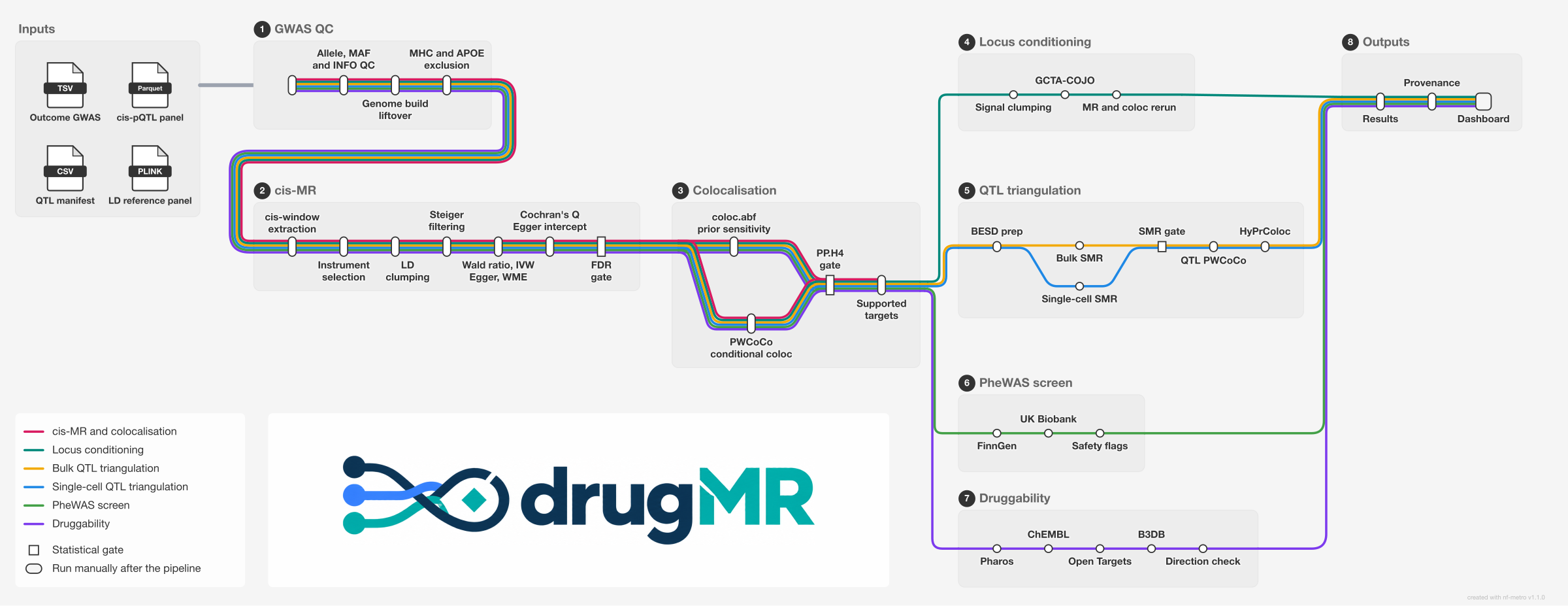
Quality-control the outcome GWAS and extract the cis region for each protein.
Run cis-MR using the selected pQTL panel (this can take several hours).
Run pairwise COLOC and conditional PWCoCo between the pQTL and outcome GWAS.
Condition the outcome GWAS on other independent signals in each supported target’s cis window with GCTA-COJO, then rerun cis-MR and coloc.
Screen colocalisation-supported targets in FinnGen, with UK Biobank as a fallback, for potential adverse effects and repurposing opportunities.
Triangulate targets with bulk and single-cell QTL data using SMR and HEIDI.
Run QTL PWCoCo and HyPrColoc across the pQTL, QTL and outcome GWAS signals.
Look up every supported target in Pharos, ChEMBL, Open Targets and B3DB, and check whether known drugs act in the direction the MR calls for.
Save the completed run under
runs/<run_id>/, then load it into PostgreSQL and explore it in the Streamlit dashboard.
Choose where each part runs
drugMR can run across different compute environments using Nextflow profiles, including locally, on HPC, or on AWS Batch and GCP Batch. The results dashboard runs on a machine with Docker Compose, normally the local computer.
Situation |
What to do |
|---|---|
Pipeline and dashboard on one machine |
Run Nextflow, then pass the run’s |
Pipeline on HPC, dashboard on your computer |
Run Nextflow on HPC, fetch the completed run with |
Pipeline on AWS or GCP Batch, dashboard on your computer |
Run Nextflow with |
Note
dm.fetch_run() is only needed when the Nextflow run is on a remote HPC or cloud machine and the dashboard will run elsewhere. It transfers the run’s locked parameter snapshot along with its results.
dm.results() always needs a configuration. For an exact local run, use dm.results(config="runs/<run_id>/params.lock.yaml"). To select the latest successful run matching a regular parameter file, use dm.results(config="params/<file>.yaml").
Citing drugMR
If you use drugMR in your work, please cite the preprint:
Comesana Cimadevila G, Dib MJ, Bracher-Smith M, Ducotterd F, Salih DA, Bray NJ, Simmonds E, Escott-Price V. drugMR: a multi-omics pipeline for genetically anchored drug-target discovery. bioRxiv. 2026. doi: 10.64898/2026.10.01.756031.
BibTeX for LaTeX users:
@article{ComesanaCimadevila2026drugMR,
  title   = {drugMR: a multi-omics pipeline for genetically anchored drug-target discovery},
  author  = {{Comesana Cimadevila}, Guillermo and Dib, Marie-Joe and Bracher-Smith, Matthew and Ducotterd, Fiona and Salih, Dervis A. and Bray, Nicholas J. and Simmonds, Emily and Escott-Price, Valentina},
  journal = {bioRxiv},
  year    = {2026},
  doi     = {10.64898/2026.10.01.756031},
  url     = {https://www.biorxiv.org/content/10.64898/2026.10.01.756031v1}
}
References for every tool the pipeline depends on are listed in CITATIONS.md.